Track HAIs day by day,ward by ward.
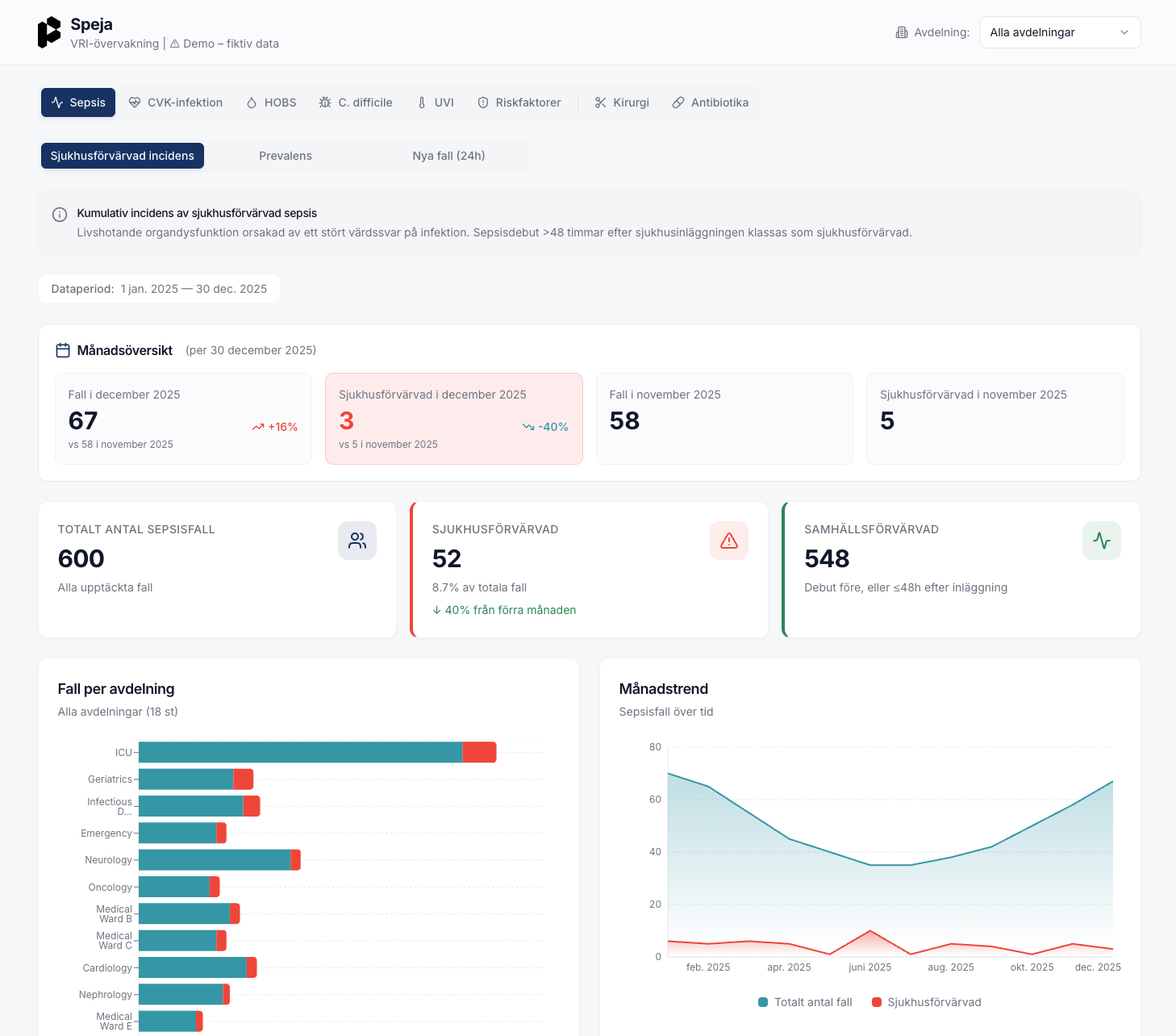
Speja automatically identifies healthcare-associated infections and surgical complications from your own data.
- Fully automated – no manual registration
- Measures the same way every day – see the effect of your actions
- Shows where infections are rising, so you can act in time
Press
Automated monitoring of adverse events becomes reality – Swedish platform strengthens healthcare quality work
P3S's platform Speja enters large-scale clinical use at Karolinska University Hospital. The algorithms automatically identify adverse events such as sepsis, healthcare-associated infections and surgical complications, giving staff daily statistics down to ward level.
Read moreP3S to improve patient safety through automated surveillance of adverse events
P3S joins Uminova Innovation as a new incubator company, gaining access to a business network, coaching and resources to scale nationally and internationally.
Read moreUBI business coach steps in as CEO for KI startup
Tobias Tovedal, business coach at Umeå Biotech Incubator, becomes the new CEO of P3S. The company develops algorithms that automatically monitor adverse events and provide daily statistics to healthcare providers.
Read moreBuilt from within healthcare
Speja originates from the VRI-proaktiv research project and is built by clinicians, researchers and healthcare professionals with extensive experience in patient safety. The solution is developed and validated in close collaboration with Swedish hospitals and is used today in live clinical settings at multiple hospitals. Speja enables digital and automated structures for HAI surveillance – with data made accessible locally and regionally, prepared for national reporting.
Prepared for national surveillance

Tobias Tovedal
CEO · Medical Technology · Software Development
Tobias Tovedal, VD

Anna Glemme
Registered Nurse · Entrepreneur
Anna Glemme

Pontus Nauclér
Professor and Senior Consultant Infectious Diseases
Pontus Nauclér

Suzanne Ruhe-van der Werff
Postdoc, KI · Automated HAI Surveillance
Suzanne Ruhe-van der Werff

Anders Ternhag
Senior Consultant · Associate Professor Infectious Diseases
Anders Ternhag
What changes with Speja?
Each ward sees its own healthcare-associated infections and can work on its own to reduce them.
Act to reduce HAIs
Measures against HAIs are taken without a baseline to compare against, so it is rarely possible to show whether they had an effect.
Every measure is compared against a baseline from your own history, as far back as your data exists, measured the same way all the time.
→ Each ward sees which of its measures reduce infections, and which do not.
See where infections arise
The picture of HAIs rests on staff registering cases themselves, and on point-prevalence measurements that count a single day. How much is missed varies from ward to ward and from time to time.
Speja measures the same way every day, so a change in the numbers reflects a change in care. Trends over time and differences between wards can be compared.
→ Each ward sees whether infections are increasing in its unit, and knows when it is time to act.
Target infection prevention support
Infection prevention often first learns that a ward has problems when someone raises the alarm.
Infection prevention sees which wards have increasing infections and can direct its support there.
→ Infection prevention's time goes to the wards that need it most.
How it works
Speja integrates into your existing infrastructure. Data is collected, assessed, analyzed, documented, structured and compiled automatically – without manual steps. All data stays with you.
Local installation
Speja is installed within your network, behind existing security solutions. No patient data leaves your data environment.
EHR-independent
The algorithms analyze your data warehouse directly – regardless of EHR system.
Automatic identification
Validated algorithms continuously identify HAIs: sepsis, CVC infection, UTI, C. difficile, surgical complications and risk factors.
Results in your tools
Statistics are presented in existing analytics tools like Microsoft Power BI.
Active algorithms
- 1Sepsis
- 2Central venous catheter infection
- 3Urinary tract infection
- 4Clostridioides difficile infection
- 5Surgical complications (Clavien-Dindo)
- 6Risk factors for HAIs
- 7Antibiotic use (DOT)
In development
- 8Pneumonia (NV-HAP)
- 9Postoperative wound infection
- 10Hospital onset bacteremia
The research behind Speja
Speja is built on validated algorithms developed and evaluated in peer-reviewed research. Below is a selection of published articles.
- 2026
Accuracy of real-time sepsis-3 surveillance across ten inpatient facilities – a prospective cohort study
Winroth A, Karlsson Valik J, Fjällström P, Kadamani T, Naucler P, Johansson AF. · Infectious Diseases
- 2026
Improved sepsis surveillance using a fully automated electronic health record-based algorithm compared to diagnostic coding
Naucler P, van der Werff S, Winroth A, Ternhag A, Johansson A. · Infectious Diseases
- 2025
Performance of an Algorithm Grading Surgery-Related Adverse Events According to the Clavien-Dindo Classification
Båverud Olsson L, Parkan D, Sjövall A, Nauclér P, m.fl. · Annals of Surgery
- 2024
The accuracy of fully-automated algorithms for the surveillance of central venous catheter-related bloodstream infection in hospitalised patients
Karmefors Idvall M, Tanushi H, Berge A, Nauclér P, van der Werff SD. · Antimicrobial Resistance & Infection Control
- 2022
The accuracy of fully automated algorithms for surveillance of healthcare-onset Clostridioides difficile infections in hospitalized patients
van der Werff SD, Fritzing M, Tanushi H, Henriksson A, Dalianis H, Ternhag A, Färnert A, Nauclér P. · Antimicrobial Stewardship & Healthcare Epidemiology
- 2021
The accuracy of fully automated algorithms for surveillance of healthcare-associated urinary tract infections in hospitalized patients
van der Werff SD, Thiman E, Tanushi H, Valik JK, m.fl. · Journal of Hospital Infection
- 2020
Validation of automated sepsis surveillance based on the Sepsis-3 clinical criteria against physician record review in a general hospital population: observational study using electronic health records data
Valik JK, Ward L, Tanushi H, m.fl. · BMJ Quality & Safety